Traditional search
A page of options
estate planning attorney near me
1
2
3
- 01Enter keywords
- 02Scan links
- 03Open several websites
- 04Compare options
- 05Choose a business
Visibility means appearing where someone can find and compare you.
AI visibility, measured
I measure whether your business gets named, and what's standing between you and getting cited.
$39 · 10 questions · 3 AI tools · 30 responses
 ChatGPT
 Claude
 Gemini
Get an early signal of how AI currently sees your business. This automated check is typically delivered in under 5 minutes, but its limited sample is not a comprehensive audit.
Local discovery
“Any good physical therapy clinics near Beverly, MA, for a knee injury?”
Problem based
“My basement floods every spring. Who handles waterproofing near Columbus, OH?”
Recommendation
“Can you recommend a good Italian restaurant in Chicago for a birthday dinner?”
Specific need
“I'm a first-time homebuyer near Denver. Which mortgage brokers work with first-time buyers?”
Comparison
“I'm deciding between two dental practices near Austin, TX. What should I look for?”
Category research
“What are some good payroll providers for a 40-person company?”
The shift
People are asking AI tools which businesses to consider. Those answers name some businesses and omit others, while most businesses have no direct view of what is being said. AI Consulting Desk measures that gap.
These neutral interface diagrams illustrate the difference in behavior; they do not represent customer results.
of U.S. adults now use AI chatbots like ChatGPT and Gemini, up from a third in 2024.
Pew Research Center, Americans and AI 2026of U.S. consumers now use ChatGPT and other AI tools for local business recommendations, up from 6% a year earlier.
BrightLocal, Local Consumer Review Survey 2026Built to measure
A proprietary measurement framework for testing how AI tools discover, describe, recommend, compare, and cite businesses.
A structured set of customer-intent questions tested across multiple AI tools reveals recurring visibility patterns that a single AI response cannot.
Does AI know your business?
Two questions test recognition. Eight test whether AI brings you up on its own.
Does AI surface your business without being prompted?
Sample report
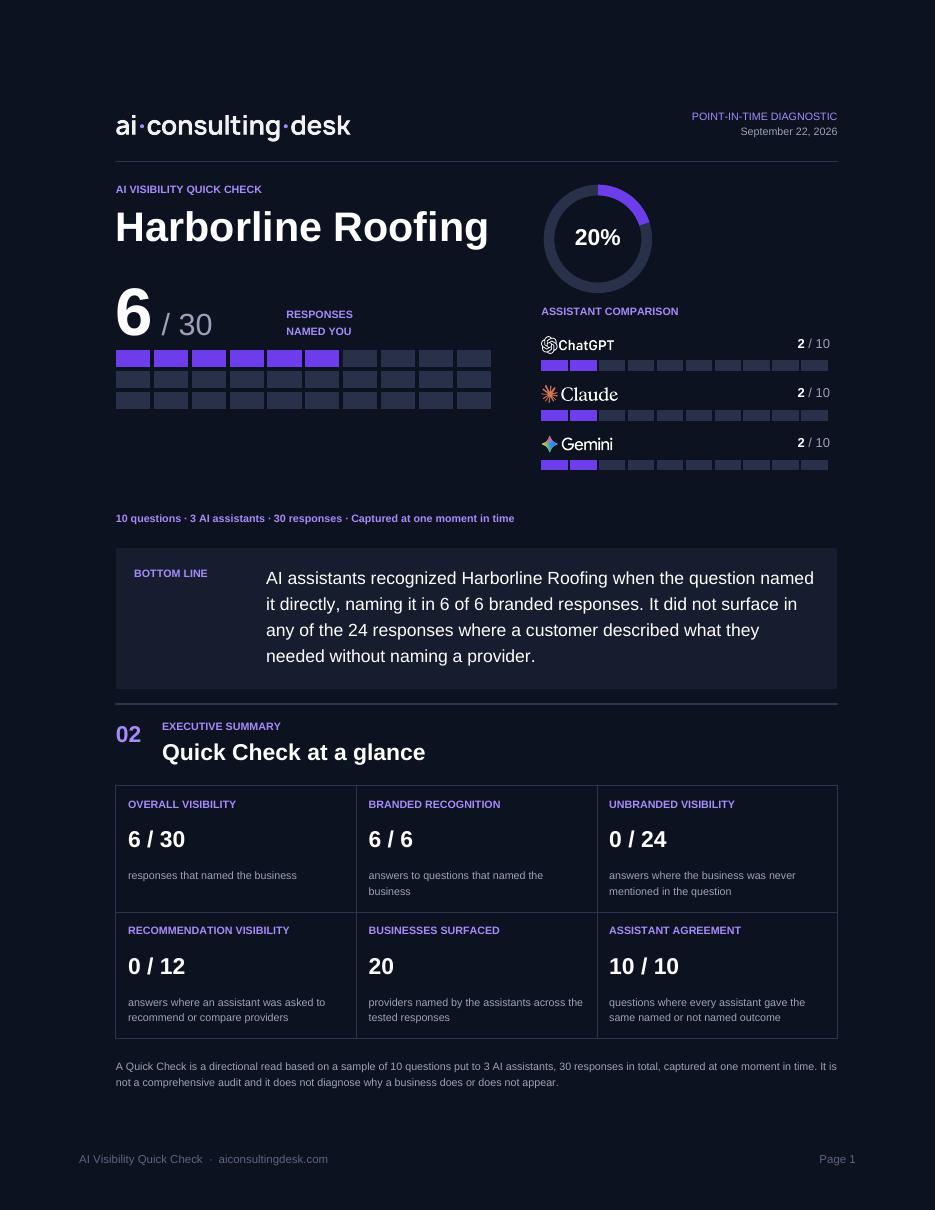
Page through a real Quick Check report with the business names anonymized. Same five signals, same structure, same evidence you receive.
Page 01The headline result and the summary at a glance
Go deeper with the human-led audit
The $499 Audit tests 75 questions across three AI tools, then turns 225 responses into findings and implications. Larger engagements expand the measurement and add strategic planning.
Discovery · Category consideration · Specific need · Comparison · Validation · Direct brand
Your presence · Who appears instead · What evidence AI relies on
"When your CEO asks whether we show up in ChatGPT, answer with a number." The Audit gives you measured mention, recommendation, and citation rates across AI tools, with baselines saved in your client workspace so the next question is what changed, not what to guess.
Illustrative distribution of cited source types within a redacted category sample.
Human-led audit reports, findings, and baselines remain available in a private client workspace.
Explore the full auditPricing
Each step answers a bigger question. Begin with a free Snapshot, unlock every answer with the $39 Quick Check, then bring in human analysis and a plan when you are ready.
Does AI know me?
A first look at whether AI knows your business.
4 questions · 3 AI tools · 12 answers
ChatGPTClaudeGeminiWhat is included
Do I have a problem?
Every answer in full, all five signals, and who AI names instead of you.
10 customer-intent questions · 3 AI tools · 30 responses
ChatGPTClaudeGeminiWhat is included
Why is this happening?
About four months of a typical SEO tool subscription, and it answers a question those tools cannot.
Human-led analysis of visibility, competitors, sources, and customer intent.
75 questions across 6 customer-intent tiers · 3 AI engines · 225 responses
ChatGPTClaudeGeminiWhat is included
How do we win?
Five AI environments, the sources behind your competitors, and a 30/60/90-day plan.
Approximately 150 questions · 5 AI environments · Approximately 750 responses
ChatGPTClaudeGemini Perplexity
 Google AI Overviews
What is included
Client add-on, billed monthly
Keep watching your baseline after your report.
Available only to clients who have completed a $39 Quick Check or a human-led audit, because monitoring compares every month against that baseline.
Custom implementation is scoped separately when you want help putting the findings into practice.
Get practical tips to help your growing business show up in ChatGPT, Claude, Gemini, and other AI tools.
About Kate and how I work
I'm Kate Porter, a marketing and strategy leader with more than 15 years of experience across Fidelity Investments, Fidelity Digital Assets, CVS Health, and Office Depot. My career has spanned marketing, technology, analytics, and emerging digital channels, from early digital and social to generative AI. Now I'm focused on AI visibility, combining AI-powered analysis with that real-world experience to understand how businesses are discovered and recommended through AI.
AI Consulting Desk combines AI-powered analysis with real-world marketing experience, through a proprietary measurement framework and a purpose-built workflow for observing how businesses appear across AI tools.
The goal isn't to make AI say something nice about your business. It's to understand what influences how often you show up, and what kind of information surfaces with your name.
Findings begin with captured responses across multiple AI environments.
The work distinguishes what the sample supports from what still needs testing.
Findings are connected to the questions, responses, and sources behind them.
The strongest opportunities are businesses with identifiable, actionable signals behind how AI represents them. Here is where that usually holds, and where it gets harder.
We don't promise visibility. We identify where there is a realistic opportunity to improve it. Not sure whether the opportunity is there? We can evaluate the actual AI landscape for your category and target searches before recommending a strategy. If the opportunity isn't there, we'll tell you.
Frequently asked questions
Straight answers about AI visibility, how the measurement works, what each engagement includes, and what happens next.
Have another question? Send a message.